

Table of Contents
- Why Purity Matters: The Benefits of Raw Unfiltered Honey
- The Water Test: Does Real Honey Float or Sink?
- The Thumb Test and Other Quick Kitchen Checks
- The Flame Test and Natural Crystallisation: What They Really Tell You
- How to Read Honey Labels: What the Jar Is Actually Telling You
- Raw Honey vs Pasteurised Honey: Why the Difference Shows in the Jar
- How to Tell If Raw Honey Is Pure: The Limits of Home Testing and What Actually Works
- Conclusion
- Frequently Asked Questions
Last Updated: September 13, 2026
Why Purity Matters: The Benefits of Raw Unfiltered Honey
Raw honey is honey that has been extracted from the comb and never heated above hive temperature, so its natural enzymes, pollen and aroma compounds stay intact. That single difference explains why raw, unfiltered honey tastes brighter, sets differently and carries far more floral character than the thin, uniform liquid on most supermarket shelves. This guide from West Country Honey walks through the home tests people rely on, what each one genuinely proves, and where they quietly fall short.
The benefits of raw unfiltered honey come down to what survives processing. Gentle handling keeps glucose, fructose, natural enzymes and pollen grains in the jar. Heat and fine filtration strip them out. If you want the full picture of why that matters, our guide to the [benefits of raw unfiltered honey] is worth reading alongside this one.
So, how to tell if raw honey is pure? No single kitchen trick gives you a definitive answer. The reliable approach is to combine several observations, then verify with the label and, where it matters, laboratory testing. Below, we cover the tests that work, the ones that mislead, and how to read a jar properly.
The Water Test: Does Real Honey Float or Sink?
Real honey sinks in water; it does not dissolve on contact. The water test works because honey has a much higher density than water, so a spoonful dropped into a glass settles at the bottom and holds its shape unless you stir it hard.
Here is how to run it:
- Fill a clear glass with room-temperature water.
- Add one teaspoon of honey.
- Watch for 30 seconds without stirring.
Genuine honey forms a cohesive blob and sinks. Adulterated honey with added syrup tends to disperse and cloud the water more quickly.
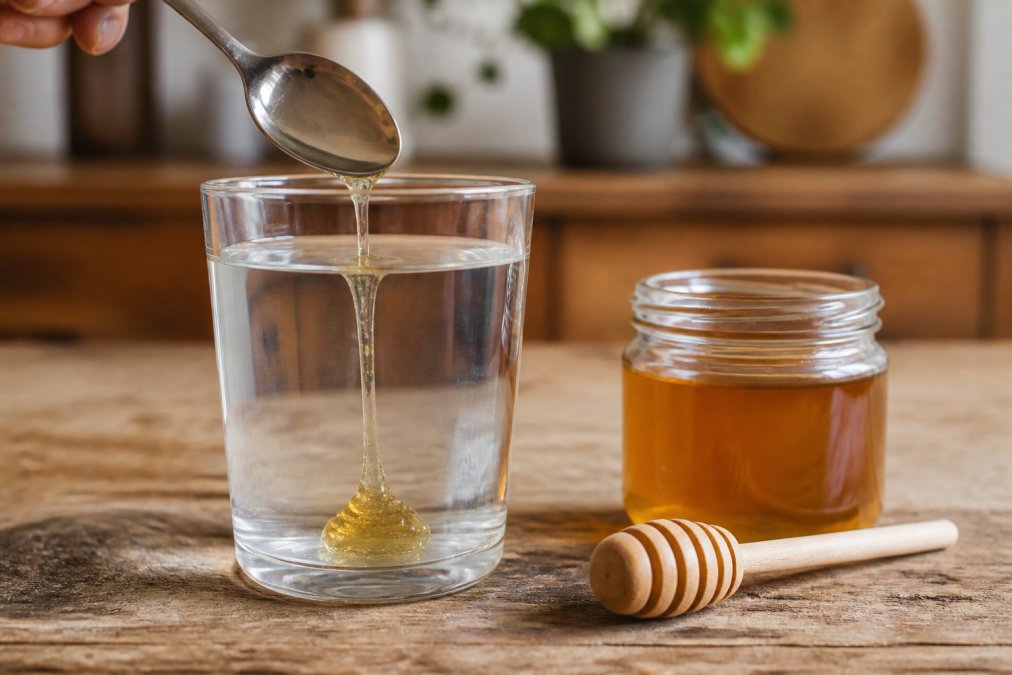
That said, the test is weaker than it looks. Syrups such as high-fructose corn syrup have a similar density to honey, so a diluted product can still sink. Treat the water test as a first signal, not proof.
The Thumb Test and Other Quick Kitchen Checks
The thumb test is the fastest check: place a drop on your thumb and see whether it holds its shape. Pure honey stays as a raised bead, while diluted honey spreads and soaks in.
Other quick checks worth knowing:
- The drip test: real honey falls in a single slow thread and piles up on itself rather than running flat.
- The taste test: pure honey has layered floral notes and a mild throat tingle; sugar syrup tastes simply sweet.
- The smell test: genuine honey carries the aroma of its source flowers, which fades quickly in heavily processed jars.
A common mistake is judging purity on viscosity alone. Viscosity shifts with temperature, so honey that flows freely on a warm day is not automatically diluted. Always test at room temperature for a fair comparison.
The Flame Test and Natural Crystallisation: What They Really Tell You
The flame test has a devoted following online, and it deserves a straight answer: a cotton wick dipped in pure honey should light and burn, while diluted honey sputters or refuses to catch. In practice, moisture content and wick quality affect the result so much that a failed flame proves very little. Honey is roughly 17-18% water in a typical ripe sample, and that residual moisture, not purity, is what determines whether a wick catches. A perfectly genuine jar from a damp season can fail the test, while a syrup blend dried down to the same moisture can pass it. Treat the flame test as entertainment, not evidence.
Natural crystallisation is a far better indicator, and it runs in the opposite direction to what most people assume. Crystallisation is a sign of purity, not spoilage. The mechanism is straightforward chemistry: honey is a supersaturated solution of two sugars, glucose and fructose, and glucose is far less soluble than fructose. Over time the glucose comes out of solution and forms solid crystals, while the fructose stays liquid. The ratio of the two sugars, which varies by floral source, decides how quickly that happens. Oilseed rape honey, for example, is glucose-heavy and can set within days; acacia honey is fructose-heavy and may stay runny for a year or more. Neither behaviour tells you anything about adulteration on its own.
What to look for:
- Even, fine-grained crystallisation throughout the jar suggests a natural, unprocessed honey. The crystals are small because natural pollen grains and tiny air bubbles act as nucleation sites, so crystallisation starts in many places at once.
- Honey that never crystallises across months or years may have been pasteurised, finely filtered to remove those nucleation sites, or cut with syrup. A jar that stays glass-clear indefinitely is a question mark, not a guarantee.
- A thin liquid layer sitting on top of a set jar is normal, not a fault. That layer is the fructose-rich fraction that has not yet crystallised.
- Coarse, gritty crystals usually mean the honey was heated and then re-set, or that a crystallised jar was stirred rather than gently warmed.
There is a UK regulatory dimension here that most guides skip. Under the Honey (England) Regulations 2015, a product sold as 'honey' must meet defined compositional criteria, including limits on moisture content, apparent reducing sugars, and sucrose, and must not have been heated in a way that destroys its natural enzymes or significantly alters its composition. That is why a jar labelled simply 'honey' is making a legal claim, not a marketing one. A product that has been heavily blended with syrup cannot lawfully carry the word at all.
How to Read Honey Labels: What the Jar Is Actually Telling You
Learning how to read honey labels is the single most reliable skill in this whole article, because the label is where producers must declare what is inside. In the UK, honey is covered by specific labelling rules, and the official guidance on honey labelling from the Food Standards Agency sets out what a jar must state.
Check these elements:
- The ingredients list. A pure honey jar lists honey and nothing else. Any glucose syrup, invert sugar or flavouring points to a blend.
- Origin wording. "Blend of EU and non-EU honeys" tells you the jar is a mix, which is legal but rarely a sign of character.
- The word "raw". This is not tightly defined, so look for supporting detail such as "unfiltered", "unheated" or "cold extracted".
- The producer. A named beekeeper or a specific region is a stronger signal than a generic brand name.
The UK Honey Regulations guidance requires accurate origin and composition claims, which gives you real use when comparing jars. If a label is vague about where the honey came from, assume the vagueness is deliberate.
Raw Honey vs Pasteurised Honey: Why the Difference Shows in the Jar
Pasteurised honey is heated, typically to improve flow and delay crystallisation, and that heat is exactly what changes the product. Raw honey is never taken above hive temperature, so its enzymes, pollen and volatile aromatics survive.
| Feature | Raw Honey | Pasteurised Honey |
|---|---|---|
| Heat treatment | None above hive temperature | Heated to delay setting |
| Crystallisation | Sets naturally over time | Delayed or prevented |
| Pollen content | Retained | Largely filtered out |
| Flavour | Layered floral notes | Milder, uniform |
| Texture | Varies by batch | Consistently smooth |
The practical consequence is simple. If you want traceability and character, raw is the better buy. If you want a jar that stays runny indefinitely, pasteurised will do that, at the cost of aroma and pollen.
How to Tell If Raw Honey Is Pure: The Limits of Home Testing and What Actually Works
Home tests are useful screening tools, but none of them is conclusive, and that is the honest answer most guides avoid. The water, thumb and flame tests all rely on physical properties, density, viscosity, moisture, that can be mimicked by syrups or altered by temperature and moisture. A jar of rice syrup thinned to the right consistency will sink, bead and burn exactly like honey. Knowing this changes how you shop, because it moves the question from 'does this pass a trick?' to 'can this jar be traced?'
What actually works, in order of reliability:
-
Pollen analysis (melissopalynology). This is the closest thing to a definitive test. A microscopist examines the sediment from a centrifuged sample and identifies the pollen grains by shape, size and surface texture. Because pollen is specific to plant species and region, the result confirms both botanical origin and whether the honey has been ultra-filtered to hide its source. Most practitioners find that a genuine raw honey contains thousands of pollen grains per 10 g sample, while heavily filtered or syrup-blended products contain almost none. The technique is standardised internationally and used by accredited laboratories; it is the method behind most honey origin disputes.
-
Sugar-ratio testing. Genuine honey has a characteristic ratio of glucose to fructose and a small but measurable content of minor sugars such as maltose and sucrose. Adulteration with high-fructose corn syrup, rice syrup or beet sugar shifts those ratios in ways that are invisible to the eye but obvious to an instrument. Techniques such as high-performance liquid chromatography and stable-isotope ratio mass spectrometry can detect added C4-plant sugars (from corn or cane) against the C3-plant signature of genuine nectar. This is the method used in the European Commission's coordinated honey adulteration testing, which has repeatedly found that a significant share of imported blended honey fails authenticity checks.
-
UK regulatory standards. Under the Honey (England) Regulations 2015, honey sold in England must meet defined compositional criteria and carry accurate origin and composition information. The Food Standards Agency enforces those rules and publishes guidance for producers and retailers. A compliant label with a named origin is therefore meaningful evidence, not because the label is trustworthy in itself, but because a false claim is a prosecutable offence.
-
Sourcing. Buying from a named producer with visible hives remains the strongest practical guarantee. A beekeeper who can tell you the apiary, the season and the floral source has nothing to gain from blending.
Food fraud in honey is a documented global problem, and the European Commission's work on honey adulteration has highlighted how widespread blending and mislabelling can be. That is why provenance beats any kitchen trick.
For anyone who wants the purest possible expression of the hive, comb honey removes the question almost entirely. Honey still sealed in the wax has not been strained, heated or tampered with in any way, and the wax itself adds a richness that extracted honey does not have. West Country Honey's Honey Comb is exactly that: honey in its purest state, just as the bees left it. For a more generous centrepiece, the A Frame of Pure Natural Comb Honey offers the same purity on a larger scale. If you prefer a jar, the 6 x 12oz /350g jar West Country Honey keeps things straightforward, and the Honey 6 x 12 oz / 340 g Jars West Country Blossom Honey brings the floral notes of the region's blossom into the kitchen.


Conclusion
Judging purity by kitchen trick alone will mislead you, and the jars that pass every test are not always the ones worth buying. Provenance, a clear label and a producer who can tell you where the honey came from will always beat a spoon and a glass of water.
West Country Honey sources from the rich flora of the south west and keeps its honey raw and unfiltered, so the floral character of each batch survives to the jar. Alongside traditional honey varieties, we offer artisanal mead in flavours such as cherry, ginger and spiced, plus beeswax products and beekeeping experience days for anyone who wants to see the process first hand.
Get started with West Country Honey and taste what genuinely raw, traceable honey is supposed to be.
Frequently Asked Questions
Does real honey float or sink in water?
Pure honey is denser than water, so a spoonful will sink to the bottom of a glass rather than dissolve. However, this test alone cannot confirm purity because thick syrups like high-fructose corn syrup also sink. Use it as one small clue alongside label checks and crystallisation behaviour. For a definitive answer, look for traceability information from the producer.
Does raw honey crystallise over time?
Yes, raw honey crystallises naturally because it contains glucose and fructose. The glucose separates from the water and forms solid crystals. This is a sign of raw, unheated honey, not spoilage. Pasteurised supermarket honey often stays liquid because heating slows crystallisation. To soften crystallised honey, place the jar in a bowl of warm water. West Country Honey's raw comb honey will crystallise over time, which is completely normal.
What are the Honey Regulations 2015 requirements for labelling?
The Honey Regulations 2015 require honey labels to state the product name, the country or countries of origin, the weight, and a best-before date. They also set compositional standards, including moisture content and sugar levels. A label that lists added syrups or flavourings cannot legally be called honey. Look for a clear origin statement and no unexpected ingredients.
What does 100% pure honey look like?
Pure honey ranges from pale gold to dark amber depending on the floral source. Raw honey may appear cloudy or contain tiny particles of pollen and beeswax. It should not be perfectly clear like glass unless it has been finely filtered and heated. Visual appearance alone is not proof, but a natural haze and visible sediment are common in unfiltered honey.